Kentucky Coal Association

Fueling Kentucky. Fueling Growth.

  • Facebook
  • Flickr
  • Twitter
  • YouTube
  • WHO WE ARE
    • OUR HISTORY
    • OUR MISSION
    • BOARD MEMBERS
  • WHY COAL?
    • COAL FACTS
    • COAL TRUTH
    • PUBLICATIONS
    • USEFUL LINKS
    • MEDIA
  • NEWS
  • GET INVOLVED
    • MEMBERSHIP INFORMATION
  • CONTACT US

April 2, 2023 by Kentucky Coal Association Leave a Comment

Europe passed its first winter test without Russian energy, keeping the lights on through this month’s cold blast. The secret to its success: burning more coal than it has in years.

Consuming large amounts of coal represents a difficult choice for European nations that had promised to ditch the carbon-intensive fuel to contain climate change. Russia’s cut to natural-gas supplies after invading Ukraine and outages at French nuclear plants have spurred the revival.

https://www.wsj.com/articles/coal-no-longer-shunned-keeps-europes-lights-on-through-frigid-weather-11671705322

March 3, 2023 by Kentucky Coal Association Leave a Comment

LEXINGTON, KY (February 24, 2023) — In comments to a homebuyer’s group at Bowie State University this past Wednesday, Vice President Kamala Harris made the astounding claim that the Biden Administration has “reduced heating and electricity bills, so folks will have more money in their pockets…” This is a claim that, frankly leaves us scratching our heads and asking ourselves whether the Vice President is speaking about some alternate universe.

“In the real world, electricity prices have gone up by almost 12 percent, fuel oil is up almost 30 percent and natural gas is up by almost 27 percent from this time last year,” KCA President Tucker Davis said. “I’m not sure where the Vice President is getting her information, but if it weren’t such a serious situation for Kentucky’s – and America’s – families, her claim would be laughable.

“But no one is laughing,” Davis continued. “Kentucky families know the reality of the situation all too well. They are the ones struggling to pay their utility bills every month. For Harris to even make such a claim leaves us with two choices – ignorance or intent. Either Vice President Harris has no clue that people’s electricity bills have skyrocketed as a result of the Biden Administration’s incompetence, or she knows and is so contemptuous of the average American voter she thinks her Orwellian ‘facts’ will be believed.

“But this isn’t Oceania, it is America in the 21st Century, where a five-minute Google session will clearly show the truth. The “Big Lie” doesn’t work here.”

“Sadly, over the next few months, the Biden Administration plans to implement a whole series of new regulations that will threaten every remaining coal-fired power plant in the country. If the Biden/Harris administration is successful in their stated goal of closing all coal-fired power plants by 2030, the current sky-high electric prices we are paying will be a fond memory. And hundreds of thousands of American households will face energy poverty, routine blackouts, brownouts and a stark choice between food on their table and paying their electric bills.

“This is a future we cannot allow to become reality,” Davis said. “We at KCA will fight this administration’s radical agenda every step of the way. And if you care about your family’s future, you will join us.”

For more information contact Tucker Davis at the Kentucky Coal Association at (859)233-4743 or via email at tdavis@kentuckycoal.co


February 2, 2023 by Kentucky Coal Association Leave a Comment

February 2, 2023 by Kentucky Coal Association Leave a Comment

Coal

QUICK FACTS

  • Kentucky is the seventh-largest coal-producing state in the nation. About one out of six U.S. operating coal mines are located in Kentucky, more than any other state except West Virginia and Pennsylvania.
  • Kentucky’s one oil refinery can process about 291,000 barrels of crude oil per calendar day. It is the 15th-largest U.S. oil refinery and provides about 1.6% of the nation’s total refining capacity.
  • In 2021, about 71% of Kentucky’s electricity net generation was coal-fired, the fourth-largest share of any state after West Virginia, Missouri, and Wyoming.
  • Kentucky has 22 underground natural gas storage sites that can hold almost 222 billion cubic feet of gas, which is about 2% of U.S. total underground storage capacity.
  • In 2021, Kentucky had the 12th-lowest average electricity price of any state and the second-lowest price for a state east of the Mississippi River. Slightly more than half of Kentucky households use electricity for their heating.

Last Updated: August 18, 2022

January 15, 2023 by Kentucky Coal Association Leave a Comment

Michelle Bloodworth | January 3, 2023 | Power Magazine

So far, utilities have announced plans to retire some 93,000 MW (nameplate) of coal— almost half the existing coal fleet—by the end of this decade. Coal retirements combined with increasing penetration of wind and solar power are the major cause for concern about generating capacity shortfalls in many regions of the country, especially during extreme weather. The North American Electric Reliability Corporation (NERC) is responsible for grid reliability across the U.S. and parts of Canada and Mexico.

In 2015, NERC gave subtle warnings about the possibility of reliability problems. “The North American Bulk Power System (BPS) is undergoing a significant change in the mix of generation resources and the subsequent transmission expansion…  the rate of this transformation in certain regions is impacting planning and operating of the BPS,” it said.

By late last year, NERC’s warnings had become more direct.

“The BPS has already seen a great deal of change and more is underway. Managing this pace of change presents the greatest challenge to reliability. … Energy risks emerge when variable energy resources (VER) like wind and solar are not supported by flexible resources that include sufficient dispatchable, fuel-assured, and weatherized generation,” it cautioned.

Accredited Capacity Differences Proving NERC’s point about the rapid grid transition, almost 64,000 MW (nameplate) of coal-fired capacity retired, and 220,000 MW (nameplate) of wind and solar capacity were added to the grid between 2015 and this year. This presents a problem because the accredited capacity of coal is 90%, while the accredited capacity of wind is a little less than 17% and the accredited capacity of solar will decline from 50% to 20% as more solar capacity is brought online, according to the Midcontinent Independent System Operator (MISO). (The accredited capacity of nuclear is 95% and natural gas is 90%, the same as coal.)

To illustrate how accredited capacity works, 1,000 MW of nameplate coal capacity can be counted on to provide 900 MW of power when electricity demand peaks. By comparison, 1,000 MW of nameplate wind capacity can be counted on to produce only 170 MW of power at peak demand. MISO, for example, has projected that its system will have 232,000 MW of nameplate capacity in 2026, but only 176,000 MW of accredited capacity.

By 2031, the MISO shortfall between accredited and nameplate capacity widens to 71,000 MW. The U.S. cannot afford to have retirements outpace additions, especially at a time when electrification of the economy (such as through growth in electric vehicles) is increasing electricity demand.

EPA Exacerbates Situation

To make matters worse, these capacity gaps do not include coal retirements that will be caused by U.S. Environmental Protection Agency (EPA) regulations. For example, the EPA estimates that its proposed Ozone Transport Rule will cause the retirement of 23,000 MW of coal, more than 10% of the existing coal fleet, by 2025. This is only one of six EPA rules that will cause more coal retirements. The other five are the Coal Combustion Residuals Rule, Effluent Limitations Guidelines, Regional Haze Rule, a replacement for the Affordable Clean Energy Rule, and revised Mercury and Air Toxics Standards. We estimate that the collective impacts of these rules will cause coal retirements to increase substantially during from 2026 to 2028, even though announced coal retirements already total more than 37,000 MW during the three-year period.

Preventing Disaster

It is time to move beyond studying the reliability train wreck that we seem headed for, and take meaningful and timely steps to prevent it, such as the following:

  • NERC’s reliability assessments are critical to help head off problems, but NERC needs to assess the impacts of a realistic number of future coal retirements. We expect NERC to issue another assessment by mid-December that takes into consideration more coal retirements than it has in the past.
  • Utility commissioners and grid operators need to pay more attention to coal retirements and EPA regulations.
  • Grid operators need to identify all the attributes that are necessary for reliability and ensure that market rules are designed to provide those attributes. The Federal Energy Regulatory Commission (FERC) should encourage such efforts by the grid operators.
  • In light of future reliability risks, we would like to see federal agencies conduct a formal reliability assessment for rules and policies that could adversely impact grid reliability. An Executive Order could accomplish this.
  • Last, there are any number of actions the EPA could take on its own to avoid causing reliability problems. These include paying careful attention to the concerns of FERC, NERC, and grid operators; deferring to states about how to implement regulations; making regulations flexible, not prescriptive; and providing adequate time for retiring coal capacity to be replaced.

We asked in recent polling what is most important to people about their electricity: that it is reliable, affordable, or produced by wind and solar? Reliability ranked number one, followed closely by affordability. Both of these ranked far ahead of wind and solar. This suggests there will be serious consequences if the EPA, utility commissioners, grid operators, NERC, FERC, and others fail to keep the lights on at a price consumers find acceptable.

—Michelle Bloodworth is president and CEO of America’s Power, the only national trade organization whose sole mission is to advocate at the federal and state levels on behalf of the U.S. coal fleet and its supply chain.

January 4, 2023 by Kentucky Coal Association Leave a Comment

LEXINGTON, KY (January 3, 2023) — The Kentucky Coal Association (KCA) applauds today’s action by State Treasurer Allison Ball taking the first steps to force the divestment of state assets from companies that push anti-coal, anti-fossil fuel, ESG (Environmental and Social Guidance) policies.

In a news release announcing the action, Treasurer Ball explained, “When companies boycott fossil fuels, they intentionally choke off the lifeblood of capital to Kentucky’s signature industries. Traditional energy sources fuel our Kentucky economy, provide much needed jobs, and warm our homes. Kentucky must not allow our signature industries to be irreparably damaged based upon the ideological whims of a select few.”

KCA President Tucker Davis said Ball’s action is a much-needed step in combating the proliferation of asset management companies and pushing a radicalized social agenda with state tax dollars.

“For far too long these companies have engaged in the manipulation of investment dollars with the specific intent of destroying the nation’s fossil fuel industry,” Davis said. “These policies are directly contrary to the best interests of Kentucky, which depends on coal, oil and gas for a substantial part of its budget and for meeting more than 90 percent of its energy needs. These companies have effectively strangled fossil fuel industries for investment capital. They have used their clout to drive decisions that are based on their own social agenda and not the needs and best interests of their investors. We welcome Treasurer Ball’s action.”

The following companies are included in the Treasurer’s list as subject to divestment of state assets: Blackrock Inc., BNP Parisbas SA, Citigroup, Climate First Bank, Danske Bank A/S. HSBC PLC, JP Morgan Chase, Nordea Bank ABP, Schroder’s PLC, Svenska Handelsbanken AB, and Swedbank.  

For more information contact Tucker Davis at the Kentucky Coal Association at (859)233-4743 or via email at tdavis@kentuckycoal.com.  

November 27, 2022 by Kentucky Coal Association Leave a Comment

FRANKFORT, KY (November 18, 2022) – The North American Electric Reliability Corporation (NERC) is warning of the likelihood of blackouts, brownouts and electricity this shortage this winter. In a report released Thursday, John Moura, NERC’s director of Reliability Assessment and Performance Analysis said, “while the grid has a sufficient supply of capacity resources under normal winter conditions, we are concerned that some areas are highly vulnerable to extreme and prolonged cold. As a result, load-shedding may be required to maintain reliability.”

In response to NERC’s report, KCA President Tucker Davis released the following statement:

“Electricity is vital to a modern economy, but more and more often our country is seeing electricity shortages, blackouts, brownouts and forced reduction of use. This simply didn’t have to happen. It was planned and an intentional part of the left’s war on coal. In 2008, coal provided more than 50 percent of the nation’s electricity. At that time, electricity was affordable, reliable and abundant.

“Between 2009 and today, almost 300 coal powerplants – 40 percent of the nation’s coal-fired generation fleet, has been closed and another 27,000 MW of coal-fired generation in 24 states is expected to retire in the next two years. It is clear that shutting down our nation’s coal-fired generation fleet has been a mistake. We simply can’t afford to continue down this road. These closures are leaving widespread energy poverty and economic destruction in their wake. We urge our elected representatives to take the steps needed not only to stop further closures of coal-fired power generation, but also to reverse the policies of the Obama and Biden administrations. We need more affordable-reliable coal-fired electricity, not less.”

November 5, 2022 by Kentucky Coal Association Leave a Comment

President Biden said Friday that “we’re going to be shutting [coal] plants down all across America” in order to shift to wind power in a comment that drew criticism from the Republican National Committee.

“I was in Massachusetts about a month ago on the site of the largest old coal plant in America,” Biden said at an event in Carlsbad, California, on Friday. “Guess what? It cost them too much money. They can’t count. No one is building new coal plants because they can’t rely on it. Even if they have all the coal guaranteed for the rest of the existence of the planet.”

https://www.foxbusiness.com/politics/biden-says-coal-plants-all-across-america-will-shut-down-replaced-with-wind-solar

October 16, 2022 by Kentucky Coal Association Leave a Comment

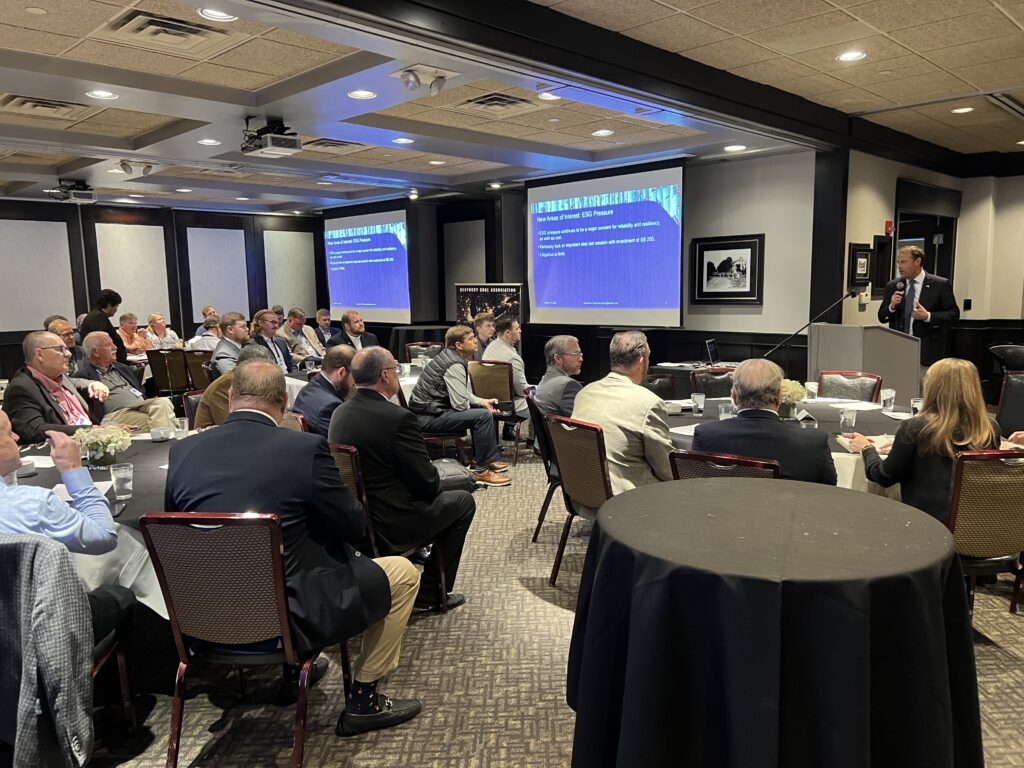
The Kentucky Coal Association held its annual meeting for 2022 on October 14 at Malone’s Prime Events Center in Lexington. Speakers for the meeting included Senator Rand Paul; Rep. Andy Barr; Kentucky State Treasurer Allison Ball; KCA Attorney Clay Larkin; KCA Lobbyist Amy Wickliffe; Mark Heath, an attorney with the law firm of Spillman, Thomas & Battle in Charleston, West Virginia, and Ambassador Kelly Craft, who is running for governor.
Ball was presented with a Friends of Coal Award for 2022.
In the photo above, Kentucky Coal Association President Tucker Davis (second from left) joins Clay Larkin, Joe Craft, David Lamb and Kentucky State Treasurer Allison Ball, recipient of the KCA’s Friends of Coal Award for 2022.

Ambassador Kelly Craft shared her vision for Kentucky’s future at the Kentucky Coal Association Annual Meeting last week.
Congressman Andy Barr joined the Kentucky Coal Association’s Annual Meeting to discuss the importance of combating the use of ESG by financial and investment firms.


October 15, 2022 by Kentucky Coal Association Leave a Comment

Weeks before international climate negotiations convene in Egypt, US officials are working to broker multibillion-dollar plans to steer some of the world’s most populous countries to cleaner forms of energy.

“We’re very much engaged in negotiating with Indonesia, with Vietnam, with South Africa and Mexico,” John Kerry, the US special presidential envoy for climate, said in an interview Thursday. “There’s a lot of energy going into these efforts.”

Kerry is set to visit Vietnam next week and will travel to Mexico again before the UN climate summit in November, he said. That comes amid ongoing negotiations with Indonesia and work to develop a detailed investment plan for a landmark $8.5 billion initiative to shift South Africa’s power system away from coal.

The regional initiatives are part of an effort to drive green energy and climate progress in developing countries, buttressing broader multilateral efforts. Rich countries have been encouraged to provide financing to support clean-energy initiatives to nations such as South Africa and Indonesia under a rubric branded “just energy-transition partnerships.”

“We’re creating a formula by which countries are able to embrace real transformation to move to a clean energy economy,” Kerry said.

Meanwhile, Kerry said he continues to press Wall Street to drive billions of dollars into clean-energy projects around the globe.

“We’re working on a way to attract private capital to the table in a way that has environmental integrity and which can accelerate the deployment of funds.”

  • « Previous Page
  • 1
  • 2
  • 3
  • 4
  • Next Page »
Kentucky Coal Association Logo

Follow US

  • Facebook
  • Twitter
  • Youtube

Get Involved

  • Our Blog
  • Membership Information

©Kentucky Coal Association 2023 | All Rights Reserved